

I always mention how important it is to know who we’re talking to before writing any piece of copy. Who’s that reader/customer? And how aware are they about the solutions you’re offering? Understanding at what stage in their customer journey are will help us write a successful message.
Does your customer know that they have a problem that can be solved thanks to your products or services?
How much do they know about your products or services?
Has this person ever heard about your brand?
Because it’s not the same writing for someone who knows what we sell, or to someone who has a problem that doesn’t even know it can be solved thanks to us. They’re at different stages of their customer journey.
This will also determine the amount of information we deliver, the words we use, the type of arguments, etc.
For example, the more unaware the customer, the more arguments we’ll need to persuade him. And vice versa.
Contents
Different copy for different stages of the customer journey
Apple, for example, doesn’t need many words to persuade you to buy their latest iPhone. Everyone knows about it, we just need to hear why this new version is more awesome than the previous one. And for some people, a photo and a title would be enough to persuade them to take action.
On the other hand, if you have a family business in Madrid, and sell traditional Chinese beauty products, you’ll need to invest more in content to make your customers see why they need what you offer and why they should choose you.
That’s why, when creating a marketing campaign — newsletters, social media ads, Google Ads, etc. — you should create specific content depending on the awareness level of each customer, or the stage in their customer journey.
The 5 awareness levels of the customer journey
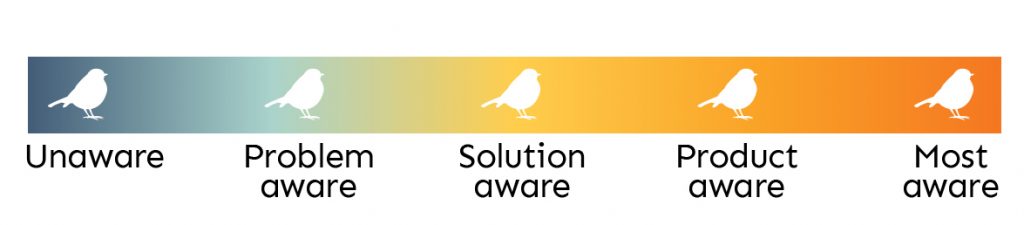
Stage 1: Unaware
Your customer doesn’t know they have a problem. It’s very difficult to market to this group because first you have to make them aware of their problem, and this isn’t an easy task in many cases.
Example:
Tony’s shower and pillow are full of hair. But he doesn’t know this is happening because he’s started losing it.
Content type: Talk about the problem they have. Make them aware of it.
Stage 2: Problem Aware
Your customer knows they have a problem, but doesn’t know there is a solution.
Example:
Tony finally realises that his hairline is receding. But doesn’t know how to stop it.
Content type: Talk about your product’s benefits. Show how it can solve your client’s problem.
Stage 3: Solution Aware
Your customer knows there are solutions, but doesn’t know about your brand yet.
Example:
Tony heard there are shampoos that can stop his hair loss, but haven’t heard about you.
Content type: Talk about how other people used your product, use testimonials, success stories, explainer videos, etc. Let them know that you are the solution to their problem.
Stage 4: Product Aware
Your customer knows about your product, but isn’t sure if it’s the right one for them.
Example:
Tony has heard about your special shampoos through online ads. But he also knows other brands.
Content type: Talk about your value proposition, why you matter to them, why you’re different. Talk about pricing, benefits and features, demos… You have to make sure they choose you over anyone else.
Stage 5: Most Aware
Your customer is very familiar with your product and is about to buy it.
Example:
Tony is a big fan of your shampoo against the hair loss. He’s even recommending it to his friends.
Content type: Talk about your prices, discounts, purchase options, payment methods, etc. Give them that final push.
Related posts:
 How to break the curse of knowledge and write an effective copy for your clients or customers
 Overcome writer’s block and write a successful text in 6 simple steps
 Writing Tips: How to Get Your Audience to Read Any Kind of Text – Long or Short
 “We don’t lock you in a contract” – Why negative language is not a good idea in advertising